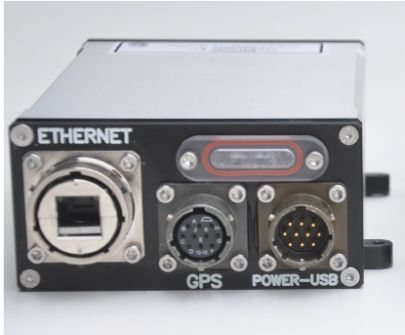
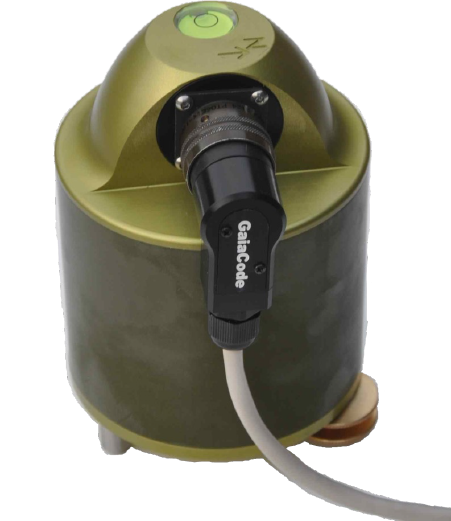
In our last news item we discussed several examples of the versatile uses of GaiaCode's THETA seismometers. Since then technicians from our distributor and partner in Latin America and the Caribbean, Grupo Ampere, have installed a THETA Borehole seismometer for a completely different application in the Chilean coastal town of Concepción. Researchers at the Faculty of Engineering at the University of Concepción want to understand the effect soil conditions have on seismic responses and at the same time they want to characterize local faults under their city. As the city is densely populated, it generates large amounts of cultural noise, which is detrimental to collecting any meaningful seismic data. For that reason, the scientists had a 80 m deep borehole drilled inside the city and installed a broadband seismometer at the bottom of the well.

GaiaCode's THETA Borehole seismometer during deployment in Concepcion, Chile Photo: Grupo Ampere
They chose a triaxial, three component THETA borehole seismometer. It has a flat response to amplitude between 30 sec and 150 Hz and is assembled in a strong waterproof stainless steel container. To obtain the optimum coupling to the borehole casing and to provide thermal insulation after the deployment, the void between the instrument and the casing was filled with coarse sand. The measurements are being sent in analogue form to the wellhead, where they are digitized and stored by a multichannel TAU digitizer and data handling system.
This installation represents the restoration and enhancement of a borehole seismic station originally deployed in 2018, which in 2024 had become non-operational and was no longer producing usable data. After the non-operational sensors and digitizer were removed, the station was reactivated using GaiaCode equipment as described above, while retaining and re-integrating an existing surface seismometer.

The plot above shows the spectra of the three components of the surface seismometer (top three lines) compared with those of the THETA at the bottom of the well (bottom three lines).
Already after a few days of equilibration of the THETA seismometer to the conditions in its new environment at the bottom of the well, the seismic measurements inside the borehole showed an enormous improvement when compared to the recordings of a similar surface seismometer. The measurements at the bottom of the well were at least 30 dB quieter than at the top - a goal that the researchers wanted to achieve by deploying a THETA Borehole instrument.