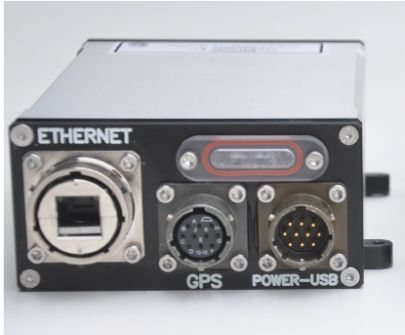
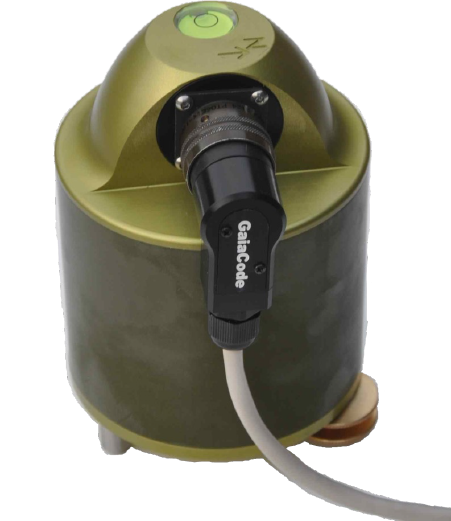
Seismometers - despite their name - can do much more than measure earthquakes. In fact they are extremely sensitive detectors to record any ground motion - be it elastic waves stemming from a seismic tremor, the rumble of the ground caused by a heavy truck driving past your house or the gentle steps of a rabbit hopping close to the sensor. GaiaCode's THETA seismometer is a prime example for the versatility of how these delicate instruments can be used to explore the hidden secrets of the Earth. Here are two recent examples of how GaiaCode customers gain answers to their scientific questions by using THETA.
Geologic Structure by Measuring Ambient Noise
Mustafa Şenkaya from the Uludağ University in the Turkish town of Bursa wants to understand the geologic structure of the Sakarya Basin in north-western Anatolia. To do that, he concurrently deploys up to eight THETA seismometers - the digital version with 30 sec upper eigenperiod - within several hundreds of meters of each other. He then records the constant rumbling of the Earth for up to 80 minutes each. Over the recent weeks, he has deployed the sensors at more then 500 locations within the basin. When comparing the measurements of this so called ambient noise by these seismometers, he can mathematically model how fast elastic waves are travelling through the underground of the basin. This results in a model of the geologic structure of the whole area based on the measurements of the seismometers.

For his geologic modelling of the Sakarya Basin Mustafa Senkaya uses the simplest form of an installation for a THETA: Put is on a level bed of sand and cover it with an all-purpose bucket to pretect it from wind noise:
Photo: Mustafa Senkaya
The Deep Rumble of Wind Turbines
Scientists and engineers from a major renewable energy company based near Liverpool are trying to find out if and how the rotation of the blades of wind turbines induces some slight rumbling of the ground. They focus their research on a remote site in Scotland. There, an array of highly sensitive seismometers currently registers the minute swaying of the ground, when excited by a - at the moment - very rare nuclear explosion. The company is using several THETAs set up in a straight line between the wind turbines and the seismic array to measure how the slight ground rumble induced by the wind turbines decays with distance.

Despite such "exotic" uses, THETA seismmometers are perfectly capable of recording regular earthquakes. Shown here is a Mw=4.4 tectonic event near Bursa, Turkey, on 2 July 2025, as recorded by four THETAs in Mustafa's experiment.