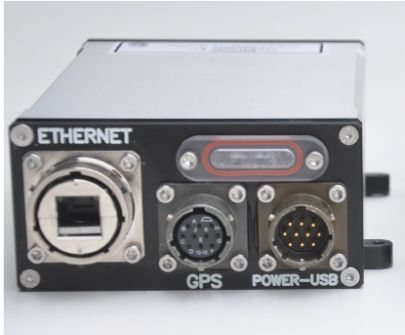
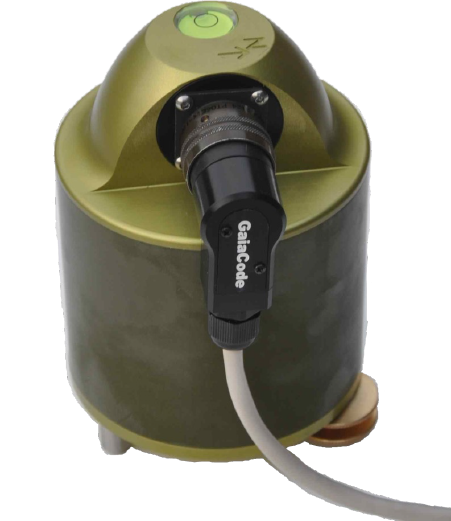
For the longest time geophysicists have been searching for new instrumentation for high quality field measurements. Many asked: Would it ever become possible to simultaneously record several important geophysical parameters continuously with a fleet of co-located sensors integrated into a single housing? Will the registrations of high quality instrumentation be compromised by a compact design and field arrangement? GaiaCode is proud to announce that we have developed, built and installed a unique multi-parameter geophysical borehole observatory that combines both worlds: High-quality low noise measurements with compact packaging and installation. As far as we know we just built and installed the first ever multi-parameter geophysical borehole observatory worldwide.
This new instrumentation allows measurement of an array of parameters relevant to ground motion simultaneously at one borehole location in one integrated data stream: Tilt, strain, dilatation, shaking and even the rock's pore pressure. Until now each of these ground motion parameters were measured with separate instruments, usually with their own data recording and management systems and typically at different locations.
Combining them all into:
- One single set of instruments
- Located at one location
- Whose data are recorded in one integrated data stream
This opens completely new possibilities of extracting scientific information. Direct comparisons say between tilt, strain and ground motion become possible without having to make multiple assumptions about wave propagation or geological properties at different locations.
At the core of this unique sensor fleet are the three components of ultra broad-band seismic feedback sensors of our proven ALPHA family. They are able to measure ground motion over a frequency range of five orders of magnitude from 2.7mHz to 270Hz (equivalent of 360sec to 0.0036sec). The three dimensional borehole tilt is measured by a high-resolution registration of the sensors' mass positions. The three-component axial tensor strainmeter is of a feedback design. Together with an integrated dilatometer the strain sensors are packaged in a separate housing, which is cemented into the base of the borehole. The pore pressure meter is also cemented into the well. A commercial geophone with an eigenfrequency of 4.5 Hz augments the instrumentation.
All sensors, except for the commercial geophones, were designed, developed, built and tested inhouse by Dr Cansun Güralp, GaiaCode's founder and Chief Technology Officer, and his team of engineers. Cansun has almost four decades of experience in designing, building and installing borehole seismometers all over the world, including in holes drilled into the ocean floors.

An example of the uniqueness of the data stream generated by this instrumentation is shown in the figure (above). It shows 3 hours of recording of the M=8.8 Kamchatka Event on 29 July 2025. The top three traces are the three components of the borehole tilt, the next three traces are the three components of the ground motion as measured by the ultra broad-band ALPHA, followed by three components of the axial strainmeter. The last trace shows the data of the dilatometer. Please note that except for the dilatometer green always shows the vertical component, red the N/S and blue the E/W - component
The first two new observatories of this kind are now installed in Türkiye as a major extension of the GONAF-Project, a joint research initiative by the Geoforschungszentrum (GFZ) in Potsdam, Germany, and the Turkish Disaster and Emergency Management Presidency (AFAD). The acronym GONAF stands for “Geophysical Observatory at the North Anatolian Fault”. Its main objective is to measure tectonic deformation transients (seismic and aseismic) along the overdue Marmara section of the North Anatolian Fault in north-western Türkiye.
For more detailed information about the new Multi-parameter Geophysical Borehole Observatory contact GaiaCode Headquarters