None of the inertial broad band seismometers based on the forced feedback principle, which are currently offered by any manufacturer, is designed to cover ground motions at high frequencies. The important criterion is the upper frequency limit of the flat amplitude response of the instrument. It is commonly defined as the point, where the amplitude response of the sensor has dropped by 3 dB with respect to the flat section at lower frequencies of the seismic band. Most broad band sensors offered today have their upper 3dB point either at 50 or 100 Hz, with two exceptions, where it lies at 150 Hz. Even in overviews of the performance of seismometers with regard to the seismic spectrum, ground motion frequencies above this range are rarely discussed.
Parasitic Resonances
There are several reasons why the higher frequency band in the spectrum is not covered by broad band seismometers. The most important of them is the fact that the current mechanical design of such sensors invariably leads to parasitic resonances at higher frequencies. Because these undesirable modes cannot be controlled by the feedback system the transfer function of such sensors becomes non-linear and is full of spikes at frequencies above 100 Hz.
Because of this mechanical limitation, the development of sensors covering higher frequencies was neglected for decades. Instead instrument designers focused on extending the low frequency (long period) responses of feedback seismometers. This led to the development of “Very Broad Band” (VBB) sensors which have their lower 3 dB point at 360 sec or more, allowing high quality recordings of normal modes, Earth tides and other very long period ground motions – if the natural signal-to-noise-ratio (SNR) in this frequency range is favorable.
Nevertheless, the Earth produces many forms of ground motion in the high frequency range of the seismic spectrum above 100 Hz. These can be caused for example by microearthquakes, hydromechanical rumblings inside a volcanoes' plumbing system, glacial movements and many more. Therefore it is desirable to design and offer a seismic sensor, which can cover a broader frequency range than the current generation of VBB instruments, particularly at very high frequencies (short periods).
Major Design Changes
We have developed a broad band feedback sensor, which is able to record ground motions in a frequency range of more than five orders of magnitude from 2.7 mHz (360 sec) to at least 270 Hz with the same linear response in both amplitude and phase. We call this new sensor design Ultra Broad Band (UBB). We have achieved this by applying major design changes to the mechanical elements of the existing broad band sensors of GaiaCode's ALPHA family. Among others some important changes are:
We designed a wider boom with an effective mass of 360 grams. This allows us to increase the distance (separation) between the pivots, thus eliminating unwanted rocking motions of the boom
Another consequence of improved boom configuration is that the Q-value of the pendulum has increased. This substantially lowers the Brownian motion (thermal noise) of the suspension system at room temperature and normal atmospheric pressure to a calculated value of -197 dB relative to 1 (m2/s4 Hz)
We increased the length of the base of the spring, which helps to shift the frequencies of its spurious resonances to values above 500 Hz.
We moved the feedback force transducer to a position at the centre of the boom, thereby ensuring that the applied feedback force has only a single degree of freedom.

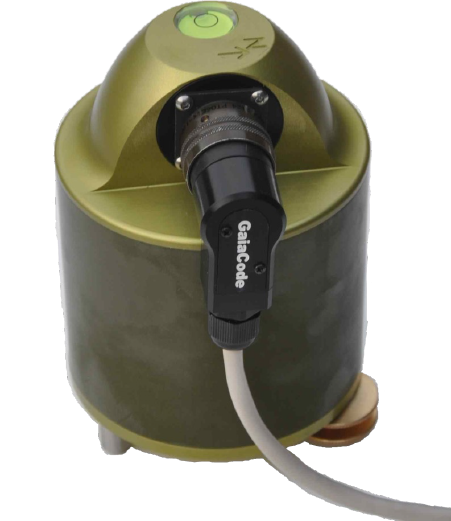
The new ultra broad band (UBB) seismic sensor based on GaiaCode’s proven ALPHA family. Shown here is a vertical component
The result is the first ultra broad band seismic (UBB) feedback seismometer with a flat response between 2.7mHz (360 sec) and 270 Hz. See transfer functions below.

Since their development, we have deployed several of these UBB Alphas in borehole seismic stations. For more information about the UBB ALPHA or to obtain a detailed data sheet, please contact GaiaCode Headquarters.