GaiaCode is part of an exciting borehole experiment in Scotland. The borehole was specifically drilled to allow for an investigation on how the recording of the ever present seismic noise changes with distance from the Earth's surface. The response function of one of our ALPHA Borehole sensors was custom designed for this project to better reflect the conditions at depth within the borehole.
Signal-to-Noise Ratio
Over the years many projects have been performed to study if deploying broadband seismic sensors in boreholes improves the recording of seismic signals versus the permanent seismic noise. However, while many of such studies showed improvement of the signal-to-noise ratio (SNR) qualitatively by installing a seismometer deeper in a borehole, only a few investigations delivered quantitative results. The specific goal of the current experiment in Scotland is to provide detailed SNR values as a function of deployment depth and frequency band in the seismic spectrum.
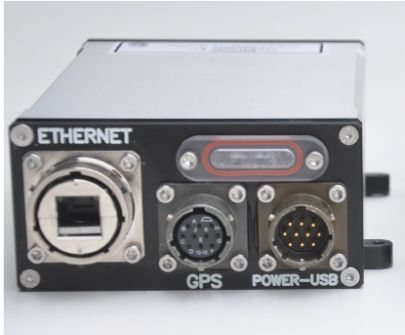
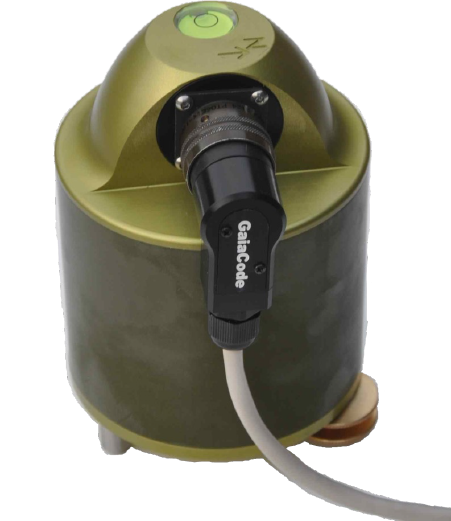
To collect the relevant data an ALPHA Borehole sensor was deployed at a depth of approximately 200 meters at the bottom of the borehole. It's data were transmitted in analogue form to the wellhead, where they were digitized and recorded by a multichannel TAU digitizer. Congruently an ALPHA Light sensor was installed on the concrete pad at the wellhead, whose data were also submitted to the TAU. Together these two data streams allow for a direct comparison of SNR at the surface and at depth.
Using GaiaCode's extremely versatile OMEGA data acquisition and analysis software, we can now investigate how the SNR's change with depths and across various frequency bands of interest. The experiment location is at the site of an established seismic array in Scotland whose continuous data are being used for additional comparison.
ALPHA Borehole with a Hybrid Response
To allow for the optimal recording of ground motion, the ALPHA Borehole has a wide frequency response from 200 seconds to more than 200 Hz. However, it's response function is modified such that it records the ground motion as acceleration in the lower frequency band from 200 to 10 secs. For higher frequencies, the response is – as typical - proportional to ground velocity.

The accompanying picture shows an hour long time series of typical seismic noise recorded with the vertical components of the ALPHA Light at the surface (green trace) and the ALPHA Borehole deployed at a depth of 200 m (yellow trace), including their respective spectrograms. In the left panel we plot in same colour scheme the spectra calculated from the same time series. At higher frequencies – beginning at 2 Hz and up - the borehole sensor (yellow line) show a substantial improvement of the SNR of up to 10 dB. The spectrum is cut-off at the Nyquist frequency of 50 Hz.